The ACUHO-I membership includes a diverse range of institutions.
Despite their differences, they share a common goal of delivering exemplary student experiences. Assessing individuals, programs, and operations, though, requires a proper measuring stick. That’s why campus housing programs rely on established professional standards to inform their strategic direction and operational procedures.
Two of the leading resources for establishing standards in campus housing are the ACUHO-I Standards & Competencies for Campus Housing Professionals and the CAS Standards. Both of these resources feature standards crafted in broad terms to better enable application across all institutions. Referring to these trusted best practices and standards provides campus housing departments invaluable ways to assess operations, identify gaps, and plan accordingly for the future.
ACUHO-I Standards
The ACUHO-I Standards & Competencies for Campus Housing Professionals provide a compendium of best practices that, while voluntary, campus housing programs are strongly encouraged to use. Standards and guidelines are used to evaluate programs, create self-assessments, shape staff training, and more. You can count on the ACUHO-I standards to help assess your department’s work across nine professional domains.
Foundations: Numerous domains compose the campus housing profession. Acting as an umbrella over all functional areas within a housing and residence life program, though, is a foundational understanding and belief in universal principles, philosophies, values, and core functions. These elements can apply to both individuals and departments.
Student Learning and Development: In addition to promoting student health and safety, campus housing and residence life departments foster student learning and development. Residence life departments achieve these goals through strategic educational programs, academic partnerships, student organizations, leadership opportunities, and support services.
Residential Facilities: Residential facilities must provide safe, clean, and comfortable living conditions for all students. They are increasingly likely to include study lounges, classrooms, kitchenettes, exercise areas, retail outlets, community spaces, and other amenities. In addition, they must meet accessibility and sustainability goals, technological needs, and budgetary constraints.
Business Management: Campus housing is vital to the student experience, but it is also a business. It must generate revenue and manage expenses while providing services that support departmental and institutional missions. Accomplishing this requires strategic management and forecasting fortified by reliable systems, policies, and practices.
Human Resources: Staff members are the campus housing department’s most valuable resource. To that end, a successful campus housing department prioritizes the wellness of its staff members, values their contributions, stays attuned to emerging trends, and maintains the flexibility in its infrastructure to respond to change.
Ancillary Partnerships: Campuses include several interdependent academic and operational departments that, in the best of times, collaborate toward the common goal of student success. Campus housing and residence life must often build meaningful relationships with internal and external entities, including academic faculty, campus partners, third-party vendors, and community groups.
Public-Private Partnerships: Business arrangements between campuses and private developers to provide student housing are not a new concept, but they have dramatically grown in numbers and importance in recent decades. A P3 is a formal relationship between a third-party entity and a college or university to provide students with housing solutions.
Emergency Management: Emergency management is a comprehensive, proactive process in which housing departments play a vital role within an institution’s broader emergency management efforts. It involves prevention, preparedness, response, and recovery, with each stage requiring detailed planning, coordination, and execution. Housing professionals contribute to this work by developing policies and procedures to reduce risks, training staff, preparing resources, supporting emergency response efforts, and aiding in post-crisis recovery.
Dining Services: Students often blur the distinction between campus housing and dining services, and at some institutions, the two are indeed managed by the same department. Today’s dining operations are increasingly asked to meet a range of dietary, cultural, and health concerns.
In addition, this resource, updated in 2025, also contains the competencies that individual professionals need to achieve the corresponding standards. When individuals understand the skills and knowledge they need to succeed, they can better plan their career path and seek out the appropriate professional development opportunities.
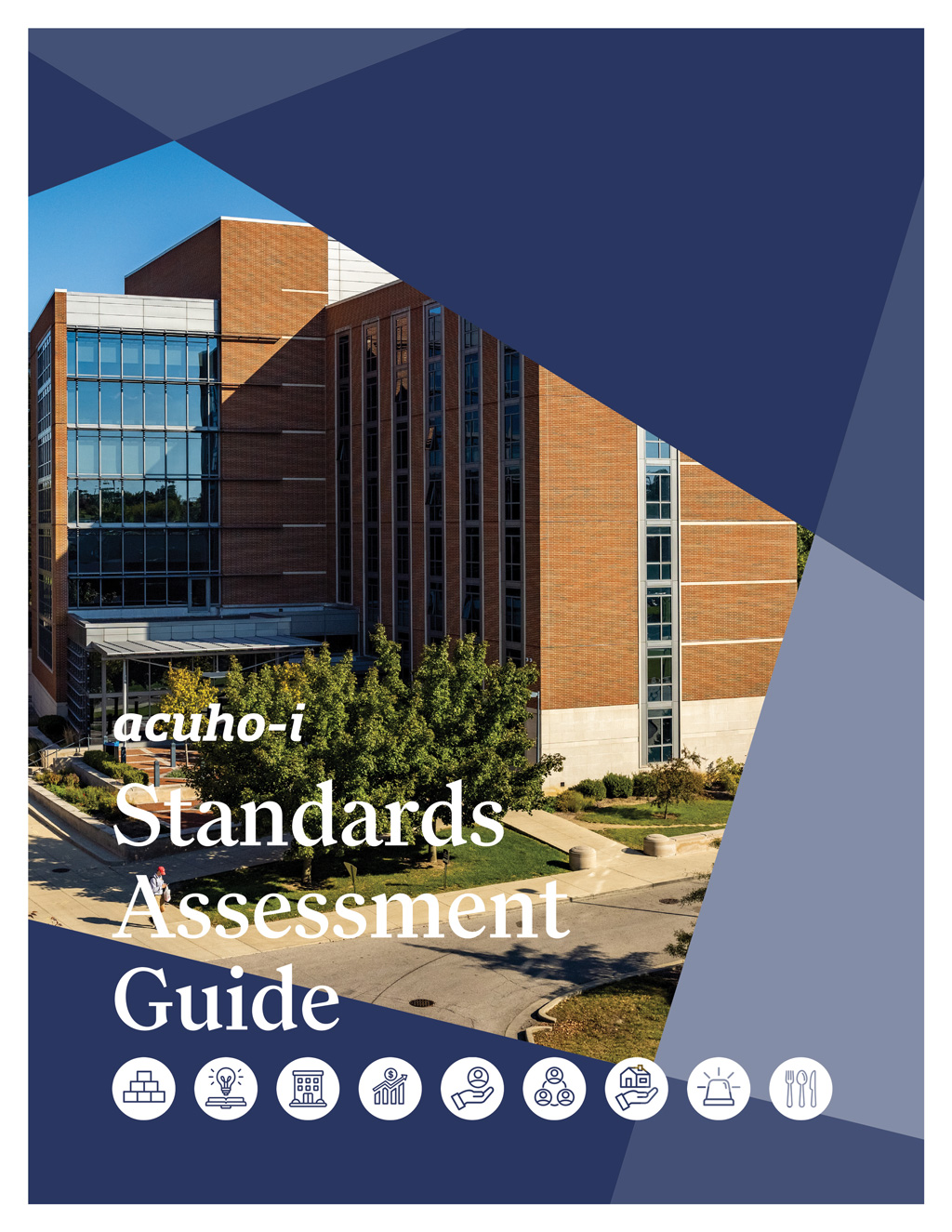
ACUHO-I Standards Assessment Guide Updated
Knowing which standards and guidelines make for a successful campus housing program is only part of the equation. To fully maximize a housing program’s potential, one must identify and assess progress towards this goal. The ACUHO-I Standards Assessment Guide is a resource that measures housing programs and services against current best practices. Housing professionals use the guide to gain an informed perspective on the strengths and areas for growth of their programs and services, then use that information to develop an improvement plan for all or selected areas of focus.
This latest edition was headed up by Amanda Knerr of Ball State University who worked with volunteer professionals to review, revise, and reimagine the standards. ACUHO-I members have free access to this vital resource through the online community. Download your copy today and begin working for a stronger, more productive department and career
An additional resource comes from The Council for the Advancement of Standards in Higher Education. With its CAS+ program, it promotes standards for multiple functional areas in student affairs, including housing and residential life. These standards foster student learning, development, and achievement, as well as promote professional practice. Designed to describe quality practice, the standards are developed through collaboration and consensus and can be applied across institutional types and sizes.
ACUHO-I works with the Council for the Advancement of Standards in Higher Education to review and report updates to the Housing and Residential Life standards. ACUHO-I members can access the CAS+ Portal at a discounted rate to explore CAS standards online, create customized self-assessment guides, and more.
Since 2024, ACUHO-I has been a member of The Program Review Collaborative along with ACUI, NASPA, and NIRSA. Representatives of the collaborative are available to provide external program review services for campuses seeking an objective, expert assessment of their programs. Leveraging a network of seasoned practitioners with expertise across operations, the collaborative pairs campuses with reviewers whose knowledge aligns closely with their program goals, areas of interest, or identified gaps. This model ensures that the review team is not only highly skilled in a specific domain but also possesses a broad understanding of student affairs and the higher education landscape. More information is available at www.programreviewcollaborative.org.
Used by Google Analytics to determine which links on a page are being clicked
30 seconds
_ga_
ID used to identify users
2 years
_gid
ID used to identify users for 24 hours after last activity
24 hours
_gat
Used to monitor number of Google Analytics server requests when using Google Tag Manager
1 minute
_gac_
Contains information related to marketing campaigns of the user. These are shared with Google AdWords / Google Ads when the Google Ads and Google Analytics accounts are linked together.
90 days
__utma
ID used to identify users and sessions
2 years after last activity
__utmt
Used to monitor number of Google Analytics server requests
10 minutes
__utmb
Used to distinguish new sessions and visits. This cookie is set when the GA.js javascript library is loaded and there is no existing __utmb cookie. The cookie is updated every time data is sent to the Google Analytics server.
30 minutes after last activity
__utmc
Used only with old Urchin versions of Google Analytics and not with GA.js. Was used to distinguish between new sessions and visits at the end of a session.
End of session (browser)
__utmz
Contains information about the traffic source or campaign that directed user to the website. The cookie is set when the GA.js javascript is loaded and updated when data is sent to the Google Anaytics server
6 months after last activity
__utmv
Contains custom information set by the web developer via the _setCustomVar method in Google Analytics. This cookie is updated every time new data is sent to the Google Analytics server.
2 years after last activity
__utmx
Used to determine whether a user is included in an A / B or Multivariate test.
18 months
_ga
ID used to identify users
2 years
Google reCAPTCHA helps protect websites from spam and abuse by verifying user interactions through challenges.
Name
Description
Duration
_GRECAPTCHA
Google reCAPTCHA sets a necessary cookie (_GRECAPTCHA) when executed for the purpose of providing its risk analysis.